
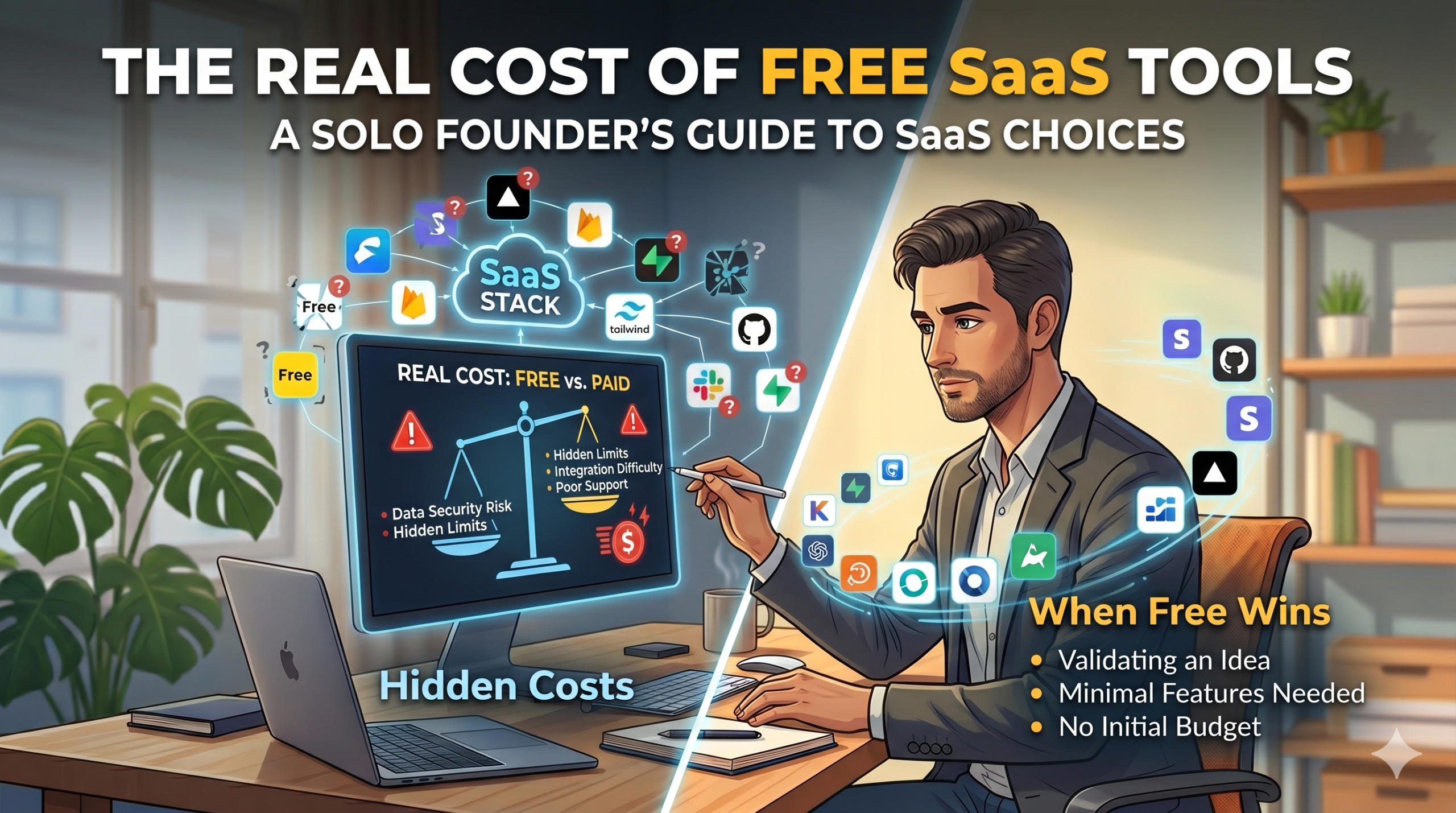

A founder I know spent two years building his customer database in a free CRM. When he hit 12,000 contacts, the platform abruptly capped his exports unless he upgraded to a $400/month enterprise tier. He had no clean way to leave. He paid the $400/month for six months while he migrated. Total cost of “free” CRM, including the $2,400 he didn’t expect to spend and the developer time to migrate: about $40,000.
This is not a unique story. It’s the most common form of expensive mistake in the SaaS ecosystem, and it almost always starts with the word “free.”
There’s a strong case that free SaaS tools are great for early-stage operators. There’s also a strong case that they’re the most expensive software in your stack on a total-cost-of-ownership basis. Both can be true at once, depending on the tool, the use case, and how aware you are of how the math actually works. This piece is an attempt to lay out both sides honestly so you can make better decisions.
The Four Hidden Costs of Free SaaS
1. The Time Tax
Most free tiers are deliberately missing features that would matter to a working professional. Manual exports, no integrations, no team access, no automation. Each of these gaps becomes a workaround you do by hand, every time.
Free tiers are designed to make the time tax visible enough that you upgrade. But many users don’t upgrade — they just accept the workarounds. After six months, those workarounds add up to dozens of hours that could have been bought back for $20-50 a month.
A test: estimate how many minutes per week you spend doing things manually because your free tool doesn’t support them. Multiply by 52 weeks. Compare to the cost of the paid tier. The free version is rarely the cheaper option once your time has any real value.
2. The Migration Tax
Free tools are sticky. They’re sticky in the way feudal serfdom was sticky: you don’t notice the lock-in until you try to leave.
Free tiers commonly omit data export, API access, or team handoff capabilities. By the time you outgrow the tool, your data is in a format that’s painful to extract. The “free” tool then converts into either an upgrade you didn’t want, or a migration project that costs developer time, lost data, and weeks of disruption.
The market has gotten somewhat better here — many vendors now offer migration assistance to acquire customers from competitors. But within a single vendor, the path from free tier to enterprise tier is much smoother than the path from free tier to a different vendor’s free tier. That asymmetry is intentional.
3. The Trust Tax
Every free SaaS tool funds itself somehow, and the funding mechanism quietly determines what the product is allowed to do. The free tier of a tool funded by data sales develops different features than the free tier of a tool funded by upselling, even if the marketing copy looks identical. First Round Review has documented how this works in practice: features that serve the actual revenue model get prioritized, while features that would benefit free users at the expense of that revenue somehow never make the roadmap. You can usually reverse-engineer how a free tool makes money by looking at which user complaints get fixed quickly and which sit in the backlog for years.
Free tools fund themselves through some combination of: data sales, ads, training AI models on your data, upselling, or burning VC money waiting for either of the first three to work. None of these are inherently bad, but they all create incentive misalignment between the vendor and you.
For low-stakes use cases (personal note-taking, reading lists, whatever), this is fine. For anything involving customer data, financial information, or proprietary work, the trust math gets harder. A free CRM that mines your contact list to train its sales-intelligence product has a real cost — it’s just one you don’t see on a credit card statement.
4. The Discontinuation Tax
Free tools die more often than paid ones. The unit economics of free tiers depend on conversion rates that don’t always materialize, and when a vendor pivots away from the free tier (or shuts down entirely), users on the free tier are usually the lowest priority for transition support. Paddle and other SaaS economics analysts have published research showing that freemium-to-paid conversion ranges between 2% and 8% across categories — meaning the other 92-98% of free users are sustained through other revenue or eventually shed.
The ones who fared worst in tool shutdowns over the last 24 months were users who had built workflows entirely around the free tier of a tool that the vendor decided was no longer worth supporting. Migration paths existed, but they were rough.
The reverse is also true: tools that have been around for 10+ years on a paid model are vastly more likely to still exist in 5 more years than tools currently giving away aggressive free tiers funded by VC capital.
When Free Actually Wins
Despite all of the above, there are real situations where free is genuinely the right answer. Three of them stand out.
Pre-revenue exploration
If you don’t yet know whether the project is going to work, you have no business paying for tools. Free tiers are made for this exact phase. The migration tax doesn’t apply if there’s no migration to make because the project never gained users. The trust tax is low because there’s no proprietary data yet. Pay zero, learn fast, upgrade only when you have evidence that the project deserves real spend.
The mistake here is staying free past validation. The moment you have paying customers, the calculus flips, and the free tier starts costing you in ways you’re not measuring.
Tools you’ll never need at scale
Not every tool needs to scale with your business. Personal note-taking, basic timer apps, text editors, simple file conversion — these are tools where the free tier is genuinely sufficient at any company size, because the use case doesn’t require enterprise features.
For these tools, paying is actually a sign you’re being upsold to features you don’t need. Stay free, save the spend for tools that compound.
Genuinely free, not freemium-trap
There’s a distinction worth making between “free forever” tools and “free tier of a paid product.” The first category is rare but real. Open-source software (Linux, Postgres, Obsidian core, Inkscape) has no upsell pressure because there isn’t a vendor selling you anything. Tools funded by other business models (Google’s free suite cross-subsidized by ads elsewhere; Apple Notes cross-subsidized by hardware sales) tend to be stable and unlikely to migrate you off.
The second category — freemium tier of a product whose business model depends on conversion — is where most of the trouble happens. Treat freemium as a free trial, not a permanent state. If you’re still on the free tier 6 months in and using the tool seriously, you’re either over-using it (likely should pay) or under-using it (should switch to a tool with a smaller paid tier).
A Framework for Evaluating Free vs Paid
When you’re considering a free tool, run it through these five questions:
- What’s the real time cost of the missing features? Estimate honestly. Multiply by 52 weeks. Compare to the upgrade cost.
- How sticky is my data? Can you export everything cleanly today? If you couldn’t, what would you lose?
- What’s the vendor’s business model? If you can’t articulate how the company makes money on you specifically, you’re either lucky or about to be unlucky.
- What’s the lifespan probability? Is this tool likely to exist in 3 years on its current terms? Look at the company’s funding stage, paid customer base, and competitive position.
- What’s the upgrade gradient? If you outgrow the free tier, is there a paid tier that’s actually a good product, or does the paid tier have its own problems? “Free upgrades to bad” is worse than “free with no clear upgrade.”
If a tool passes all five, free is genuinely the right answer. If it fails two or more, paid is almost always cheaper on a TCO basis.
The Meta-Lesson
The instinct to use free tools is correct early in any business. The instinct to keep using free tools after early validation is one of the most expensive mistakes a small business can make.
The honest test: are you on the free tier because the free tier is sufficient, or because you haven’t gotten around to upgrading? If it’s the latter, you’re paying the time tax, the migration tax, or the trust tax — you just haven’t seen the bill yet.
Free is a tool. Like any tool, it has a job it’s good at and jobs it’s bad at. Knowing which is which is worth more than the cost of paid tiers.
